


1. Context
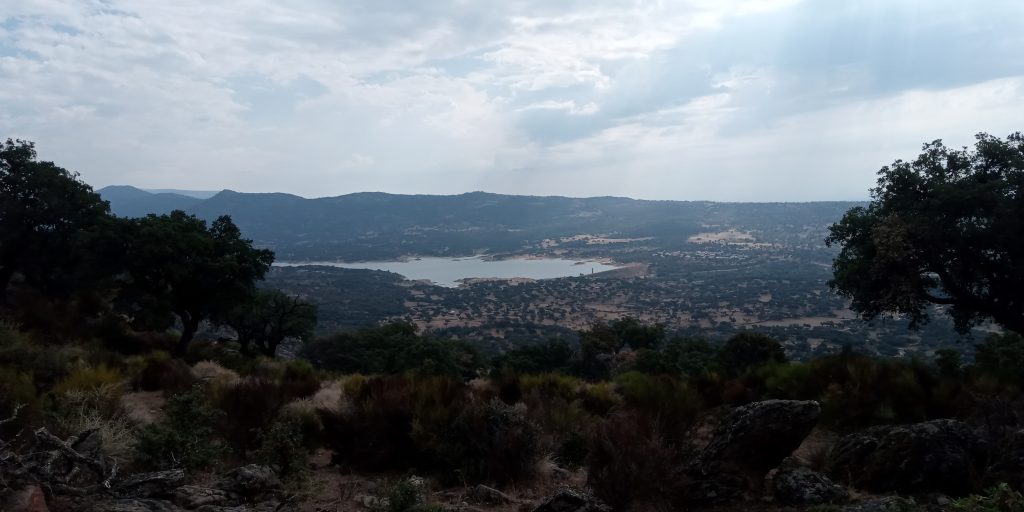
The Monte Valcorchero estate is located in Plasencia (Cáceres). It is owned by the Plasencia City Council and has been declared a Protected Landscape within the Network of Protected Areas of Extremadura. The estate covers approximately 1,184 hectares in the Sierra del Gordo, in Plasencia. It is largely wooded, consisting of cork oaks, holm oaks and small groves of hackberry trees, with areas of rocky outcrops and shrubs such as hawthorn and gorse. The terrain is very rugged and uneven, with deep valleys and heights of up to 750 metres. The estate is used for livestock farming, hunting, recreation, firewood extraction, cork and mushroom harvesting. The livestock consists of Avileña cows, with around 258 head spread over two plots, and 400 head of cattle on another plot, making a total of three plots dedicated to this use on the mountain. This means that the entire mountain is occupied by livestock throughout the year. There are several very popular routes (on foot or by bicycle) among the citizens of Plasencia for exploring the mountain and its springs.
The wetlands on the estate are of great importance, both ecologically and for popular uses. In total, there are 14 ponds that usually dry up in summer, except for two that remain full of water. There are also three wells. Of particular note is the large number of springs scattered throughout the territory, which are of great heritage value. There are 32 in total, of which at least 14 are natural. There are several areas of puddles and springs of lesser importance in the shady areas of the estate, most of which suffer from summer drought.
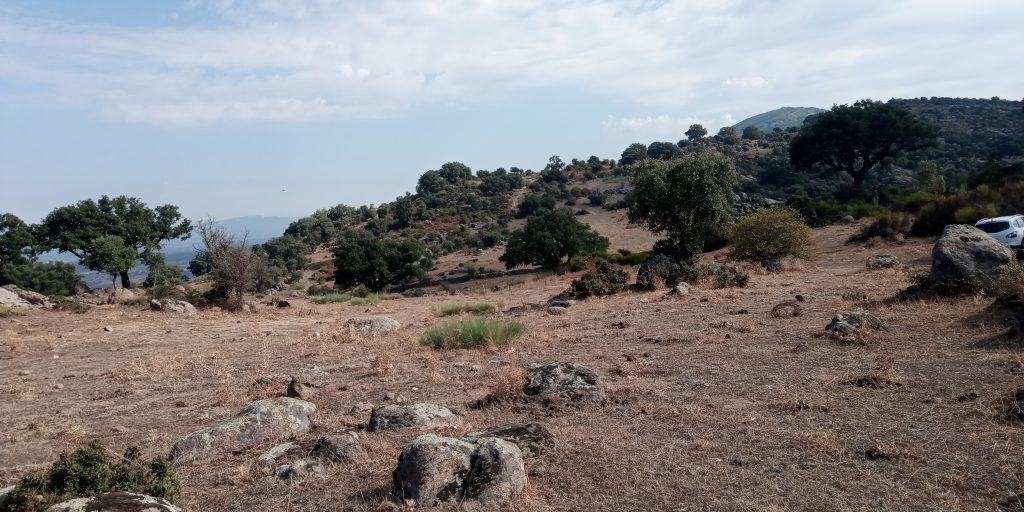
In general, the soil is poor, rocky, granitic, with some organic matter, especially in the more forested areas and near rocky outcrops or islands of shrubs, due to the contribution of organic matter under the canopy. In some areas, it is very compacted due to trampling by livestock, excessively grazed and with little regeneration and abundant slurry and excrement, which eutrophicate some ponds. The scrubland has a large number of rocky outcrops that provide shelter from herbivores and allow trees and shrubs to regenerate. The tree layer is dominated by cork oaks (Q. suber), which show a low capacity for regeneration. Several attempts have been made to thicken holm oak and cork oak stands, but most have been unsuccessful due to a lack of maintenance in subsequent years, with almost all the trees drying out, leaving only a few specimens surviving. The dominant scrub species are Cytisus multiflorus, Cytisus scoparius, Asparagus sp., Crataegus monogyna and Pyrus bourgaeana. Other species present are Rosa canina, Rubus ulmifolius and Daphne gnidium. The area where the actions will be carried out is located near a gabion on the boundary of the property with a neighbouring private property and in a group of temporary ponds that serve as a refuge for amphibians.

Actions
Measure: Linear shrub infrastructure in the stone wall to act as natural boundary
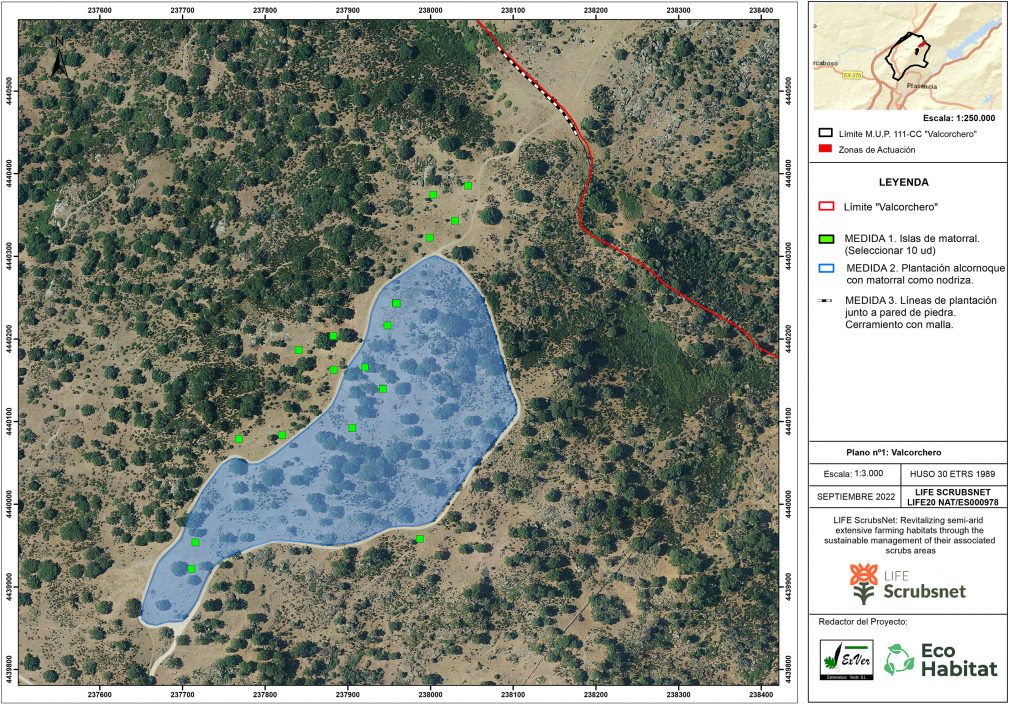
In Valcorchero, there is a stone wall that acts as a farm limit with the private property of the adjoining farm. This stone wall has been restored and conditioned and a linear arrangement of thorny scrub plants has been placed, with the aim of generating a completely natural limit over time. A mixture of three species that are very present in this forest, Crataegus monogyna, Rubus ulmifolius and Pyrus bourgaeana, together with some cork oak seedlings, have been introduced randomly and dispersedly among these thickets. A linear fencing has been installed in order to protect the planted seedlings with the aim of give representation to the shrub and tree layers within this linear structure. After two years, the stone wall looks like greener, thanks to the fast growth of natural and planted specimens of Rubus ulmifolius, which has colonized the wall structure. Moreover, some individuals from Crataegus monogyna and Pyrus bourgaeana are present. Regarding the regeneration of the tree layer, the fencing has allowed the survival of some planted individuals of Quercus suber and the appearance of some individuals of Quercus ilex and Celtis australis from natural regeneration.

Measure: Shrub islands for the improvement of the biodiversity of the system
In Valcorchero, 10 shrub islands of 36 m2 have been created in areas of the farm completely devoid of woody vegetation. To this end, a fence has been installed for the delimitation and protection of the vegetation and a total of 180 seedlings have been planted on each island (January 2023), representing 16 species selected according to the ecosystem function they play within the pasture. Subsequently, maintenance and replacement work has been carried out. The monitoring results indicate an average survival rate of 30% after two years for the species used (considering the total number of islands), with the most successful being Ulex europea (52%), the three species of Cistus (37-48%) and the two species of Salvia (43%). Some species such as Genista hirsuta, Arbutus unedo or Myrtus communis show a very low survival rate (7-14%). After two and a half years since the creation of the islands, the presence of green areas can be observed in the area, even in conditions where the grass has already dried, which are due to the presence of these islands. We hope that the presence of these shrub species will favor the general biodiversity of the farm, which we hope to verify by monitoring the wildlife associated with the shrub layer (pollinators, birds, reptiles and amphibians).


Measure: Regeneration of the system by direct seeding of acorns and seedlings from the farm
In Valcorchero, acorns have been harvested (autumn 2023) that have been encapsulated (pre-germinated) and sown under shrubs already present on the farm that can act as “nurses” and thus promote the development of the seedling. Generally, they have been planted under individuals of the species Pyrus bourgaena, Crataegus monogyna and Cytisus scoparius. In addition, 38 units of high-quality Q. suber seedlings obtained from acorns collected on the farm itself have been planted in the stone wall protected area.
